









Written by: Conrad Baker + Holly Watson
Environmental Educator, New York State Parks, Recreation & Historic Preservation
County Historian, Livingston County, New York
Most folks with a time machine wouldn’t immediately set the dial to the pre-1700s Genesee Valley. They’d probably assume there would be nothing here but “wilderness,” and you’d have to forage to survive. But they’d be missing out. Nobody talks about it, but this was already a well-known, abundant land centuries ago. Foraging was and remains a pleasurable activity that you can dabble in yourself.
It was hardly a “wilderness” even where the Genesee River slithers on muddy floodplains, glides through the green valley, and rumbles over Canyon Falls. The Onondowaga, or “Seneca” people of the Haudenosaunee, or historically, “Iroquois,” built permanent farm towns here, places with names like Canawagus, sulfur springs known as the “Place of Stinking Waters,” where a traditional footpath became wagon roads and later Routes 5 & 20, or Squawkie Hill, which gave refuge to displaced Great Lakes people, whose road became the north entrance to Letchworth State Park.
At the Treaty at the Town of Big Tree, held near present-day Geneseo in 1797, the Seneca Nation ceded much of its original territory west of the Genesee River but reserved several parcels along the river that encompassed existing Native towns.
Canawaugus, along Route 5, roughly translates to the “Place of Stinking Waters” because of the nearby sulfur springs. Big Tree, just across the river from Geneseo, took on the name of its leader. Little Beard’s Town was near today’s Cuylerville and is marked by the Torture Tree, a massive oak symbolizing legends almost 250 years old. Squawkie Hill, located at the northern entrance of Letchworth State Park, was home to a group of Meskwaki, people displaced from the upper Midwest. An almost 18,000-acre area spanning the river gorge in Letchworth, from Silver Lake to Ridge in Mount Morris, was called Gardeau and is remembered as the home of Mary Jemison.
Finally, Caneadea Reservation straddled the Genesee River from the mouth of Wiscoy Creek to present-day Houghton. Although these reservations were all dissolved by 1826, the Seneca Nation continues stewardship of several reservations in their original territory, including Cattaraugus and Allegany.
To these Onondowaga, food came from generational cooperation with the soil and the elements. Every 4th grader can tell you the staples of the traditional Haudenosaunee diet are corn, beans, and squash. What sounds like three ingredients are actually hundreds. Consider the wide varieties of corn (including popcorn), the “beans” from clover all the way up to catalpa and locust trees, and squashes, maybe the most diverse of all, which include gourds, pumpkins, zucchini, cucumbers, and melons. Foraging or even hunting would have been supplemental to this mostly vegetarian diet, finding fats and flavors.
In any of your travels through this stunning forest landscape, even in the chilly autumn or the truly cozy winter, you will find colorful little shelf mushrooms sprouting out of every other downed log in the woods. It’s one of the most abundant local wild mushrooms and one of the most discussed entry-level foraging items.
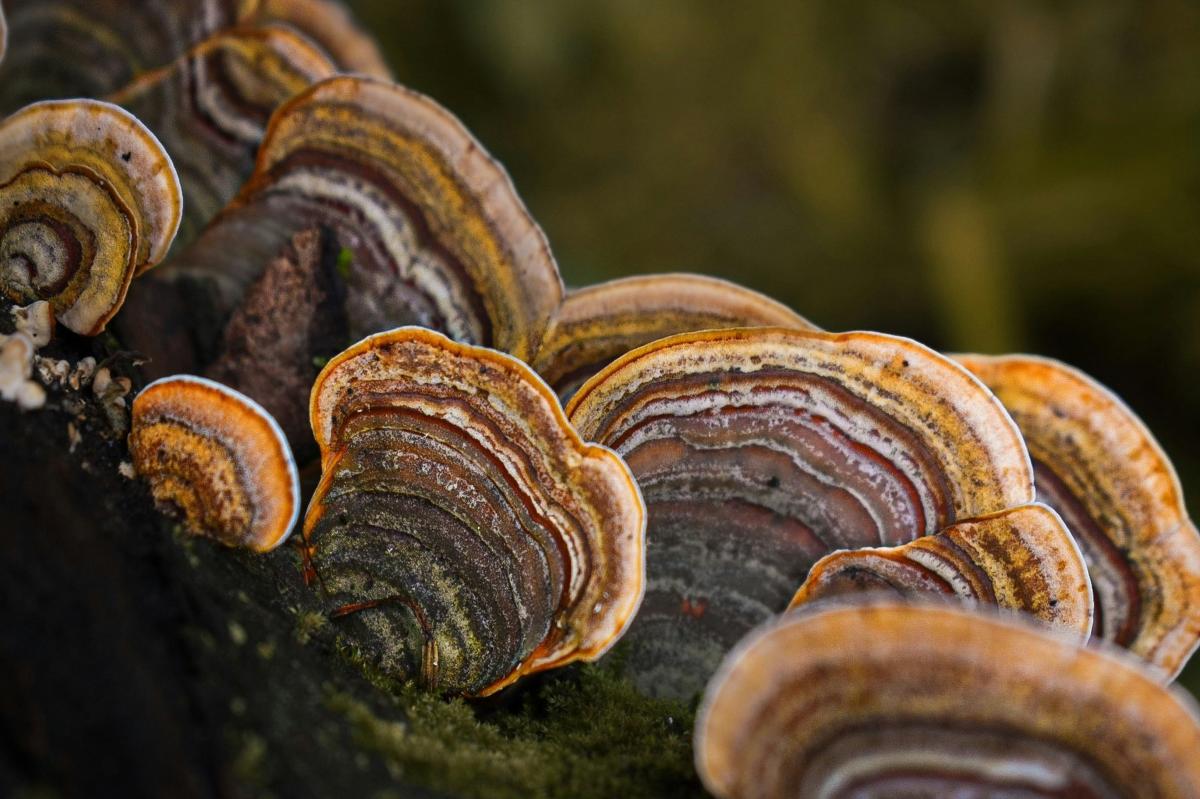
The mushroom grows year-round, always on rotting logs. It’s fuzzy, with multicolored growth rings on top, a leathery texture, smooth underside with no visible pores. Those are turkey tail mushrooms.
Turkey tail mushrooms are the subject of viral and often disputed claims online. Some say even home remedies with no special equipment can cure diseases. This seems to generally not hold water. Only sophisticated lab equipment can extract certain compounds from these mushrooms, but they do make a great tea or broth.
For a bonus, you could sweeten your tea with local honey (which the Genesee River Valley is also known for). Stop by Cornerstone Farmstead in Caledonia for all kinds of authentic fruits of the valley, including honey.
Like traditional indigenous peoples who first farmed here, foraging is a pleasure, not a necessity. Turkey tail is such an abundant flavor with no harmful lookalikes. It’s a great wild accent to cap any cozy season adventure.
FIELD NOTES:
- Foraging is generally not allowed except in state forests (different from state parks) or unless given permission by a private landowner.
- The foraging items mentioned are quite safe. They have no toxic or distasteful lookalikes. However, foraging other species can require advanced field identification skills and is not recommended for beginners.
- It is never good foraging etiquette to take the first or only item you see. Wait to find a cluster of your target items growing, and take only a few small pieces.
MAKE YOUR OWN: TURKEY TAIL TEA
To make one cup, you’ll need 2-3 fans of turkey tail mushrooms, bases trimmed off, and washed thoroughly in cold water.
Instructions:
- Chop roughly and drop into 8oz water
- Simmer gently for about 30 minutes
- Strain and discard the mushroom
- To finish, stir in honey to taste
This tea can be endlessly customized by adding a squeeze of lemon, infusing other herbs, or including green or white tea leaves—other delicate flavors are best so you don’t overpower the light earthiness of the turkey tail